
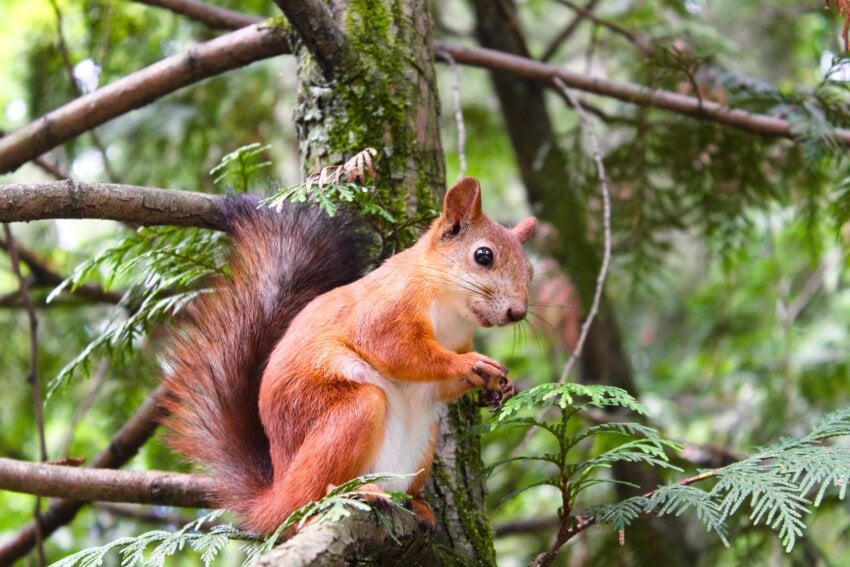
Let’s have something really fun this time around in Language Day! Winter turning into spring (in the Northern hemisphere), and while there is still snow - and even ice - on the ground in some northern countries, we are seeing more and more of the so pleasantly warming sun, and welcoming the spring once again. But we can still muster a few snowballs, and maybe try to with one of them hit an oak tree that in a few weeks will be getting leaves, and acorns for squirrels to pick up and eat, and store.
So, we get to today’s word in Language Day: squirrel! This English word for our cute rodent (well, some people might disagree of course) was first attested in the year 1327. And it comes from the Anglo-Norman esquirel <– the Old French escurel <– a reflex of a Latin word sciurus <– the Ancient Greek word σκίουρος (skiouros). See the rest of the names, in these languages, here below:
ARABIC - Sanujab
CHINESE ?? 松鼠 (sōngshǔ)
CROATIA ?? Vjevericha
CZECH ?? Veverka
DANISH ?? Egern
DUTCH ?? Eekhoorn
ENGLISH ????????????? Squirrel
ESTONIAN ?? Orav**
FINNISH** ?? Orava (o-ra-va)
FRENCH ?? Écureuil
GERMAN ?? Eichhörnchen
GREEK ?? σκίουρος (skiouros)
HAWAIIAN Squirrel
HINDI ?? गिलहरी (gilaharee)
HUNGARIAN ?? Mókus**
ICELANDIC** ?? íkorna**
IRISH** ?? iora
ITALIAN ?? Scoiattolo
JAPANESE ?? リス (risu)
KOREAN ?? 다람쥐 (dalamjwi)
LATIN - Sciurus
LATVIAN ?? Vāvere
LITHUANIAN ?? Voverė
NORWEGIAN ?? Ekorn
TAGALOG ?? Ardilya
POLISH ?? Wieviórka
PORTUGUESE ?? Esquilo
RUSSIAN ?? белка (belka)
SAMOA ?? Squirrel
SERBIA ?? веверица (veverica)
SPANISH ?? Ardilla
SWAHILI - Squirrel
SWEDISH ?? Ekorre
TURKISH ?? Sincap
UKRAINIAN ?? білка (bilka)
WELSH ??????? Wiwer
Updated 29.3.2023