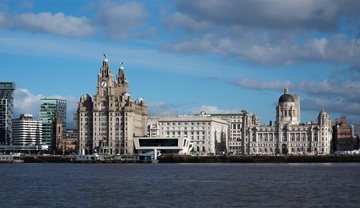
This article in our article series Streets & Squares is about Liverpool, a coastal city and metropolitan borough in Merseyside in western England. In the 19th century, Liverpool was a major port of departure for English and Irish emigrants to North America. With the metropolitan area it has today a population of well over two million people. Besides the port, Liverpool is of course world famous for its ardent football supporters - and the Beatles!
Liverpool is divided by River Mersey, with the main area of the city being on the right side. The name Mersey is derived from Old English, and means “boundary river”. Possibly referring to its having been a border between the ancient kingdoms of Mercia and Northumbria - which certainly rings a bell for anyone having followed the television series Vikings.
So, let’s see who are the people behind the eponymous street signs of Liverpool! As always in Streets & Squares, clicking on the address links leads you to Google Maps, and clicking on the names to the person’s Wikipedia page. This will be the most extensive study of the eponymous streets of a city in this series, due to the giant contribution of a site called Liverpool Picturebook ! So if you want to check also the non-eponymous street names in Liverpool, you know where to go.
This article is to be updated.
ABERCROMBY SQUARE - Ralph Abercromby (1734-1801) was Commander of the British Army, politician and Governor of Trinidad who was killed in the battle of Alexandra. Born in Menstrie, Clackmannanshire, Scotland - StreetView - Wiki
ADDISON STREET is named after Joseph Addison (1672-1719) who was a poet, essayist, playwright and a politician. Born in Milston, Wiltshire, England - StreetView
ARGYLE STREET - Called after John, Duke of Argyll, celebrated by Scott in “The heart of Mid-Lothian”.
ASHTON STREET - Nicholas Ashton (1742-1833) succeeded his father John Ashton as owner of the Dungeon salt works. He was also a shipowner, and High Sheriff of Lancashire in 1770. StreetView
**ATHOL STREET **- Named after the Duke of Athol, on whom an Honourary Freedom was conferred by the Town Council
BANASTRE STREET (Southport) Banastre Tarleton (1754-1833) was a general and later politician who took part in the American Revolution. He was born in a house on the corner of Fenwick Street and Water Street in Liverpool. StreetView
**BASNETT STREET **- Laid out between 1770 and 1780 by the Basnett family of which Christopher was the founder. He was the first minister of Key Street Chapel (licensed in 1707), the meeting place of the Protestant Dissenters.
BEAUFORT STREET - Named after the Duke of Beaufort, formerly the Marquis of Worcester, who was the guardian of Charles William, 8th Viscount Molyneux and 1st Earl of Sefton, who was orphaned when eight years of age.
Beauclair Drive - Named after the Duke of St Alban’s family, the Beauclerks, who inherited the Speke Estate of the Norris’s
BELOE STREET - Named in compliment to Charles Henry Beloe, a civil engineer, who sat as a Liberal for Abercromby Ward on Liverpool City Council from 1892 to 1902.
BENSON STREET - Called after John Benson, the refractory juryman referred to in one of the Letters of Junius addressed to Lord Mansfield, the Lord Chief Justice of the King’s Bench.
BERRY STREET - Henry Berry (1719-1812) Liverpool’s second dock engineer who lived in a house on the north-east corner of Duke Street. Designer and builder of docks and canals. StreetView
BIXTETH STREET - Alderman Thomas Bixteth, Mayor of Liverpool in 1701, was complimented by the Corporation for having paved the street in front of his house with his own hands.
BLACKBURN PLACE - John Blackburn, Mayor of Liverpool in 1760, lived in Blackburn House between 1785 and 1790.
BLAKE STREET - Named after Admiral Robert Blake (1599-1657), who became commander of Parliamentary forces during the Civil War but, in 1649, was appointed General-at-Sea and won several victories against Prince Rupert, the Dutch and the Spaniards.
BOLD STREET - Jonas Bold was a sugar merchant, mayor and slave trader who leased land from the Corporation on which St Luke’s Church and a ropery owned by James and Jonathon Brookes were built. StreetView
**BOLTON STREET ** - Perpetuates the memory of John Bolton who, 1803, raised and equipped 800 men at his own expense. They became known as Bolton’s Invincibles. On December 20th, 1805, Bolton fought and won the last duel to take place in the town.
BOOKER AVENUE - Josias Booker was a West India merchant who lived in Poplar Grove, Allerton. He was one of the founders of St Anne’s Church, Aigburth.
BOWRING PARK AVENUE - Sir William Benjamin Bowring gave to the city Ropy Hall and Park which was renamed Bowring Park.
BRIDPORT STREET - Alexander Hood (1726-1814) was the 1st Viscount Bridport and an officer of the British Royal Navy during the French Revolutionary Wars and Napoleonic Wars. StreetView
BRODIE AVENUE - John Alexander Brodie, Liverpool’s City Engineer (1898-1925). In 1891, he invented and patented football nets and, in 1901, he patented the idea of prefabricating houses from reinforced concrete slabs. He also introduced the idea of using central reservations for tramcars. The first reserved track, Edge Lane to Broad Green, was completed in 1914.
BROOKS ALLEY - Joseph Brooke, was a merchant and a ropemaker who lived in a house in Hanover Street. It had an ornamental garden through which the alley was laid. StreetView
BROOKLAND ROAD - Named after the Venerable Archdeacon Brooks (1775-1855), Rector of Liverpool, who owned land in the vicinity.
BROUGHAM TERRACE - Henry Peter, 1st Baron Brougham and Vaux, was a lawyer, Whig politician and Lord Chancellor of England. He was a friend of the Rev. William Shepherd, minister of Gateacre Unitarian Chapel, and it was Brougham who composed Shepherd’s memorial tablet in that chapel.
BUTTON STREET - John Button was granted a lease on the land through which the street was cut in 1722. He recorded his vote in 1784, having lived through the reigns of six monarchs of England.
BYROM STREET - George Byrom was a pavior and builder, who had a yard nearby. StreetView
CAMDEN STREET - Sir Charles Pratt, 1 st Earl of Camden (1713-1794) was called to the Bar in 1738. He was Lord Chancellor (1766-1770), President of the Council (1782-1794) and was created Earl of Camden in 1786.
CAMPBELL STREET - George Campbell, a West India merchant and sugar boiler, was Mayor of Liverpool in 1763. The name Pot House Lane derived from a pottery.
CANNING PLACE - George Canning (1770-1827) was a Tory statesman with the shortest tenure as PM as he died in office. Born in Marylebone, London. In Liverpool he helped with plans to erect a new Custom House and other Revenue Buildings. StreetView
CARLTON STREET - Carlton was the name of a leading member of the board of the City of Dublin Packet Company whose premises were nearby.
**CARVER STREET - **Mr Carver, Steward to the Earl of Derby had a house there.
CASES STREET - Thomas Case was a slave trader, colliery owner, and nephew of the industrialist Sarah Clayton (see below) after whom she named a street leading to Clayton Square. Together the Clayton-Case alliance controlled the coalfields along the Sankey channel in Liverpool. StreetView
CATHERINE STREET - Called after his mother by William Jones (1788-1876), who built houses in the city’s Bloomsbury area. He built his own house, 35 Catherine Street, where he lived until his death.
CAZNEAU STREET - Joseph Cazneau, a merchant, built the first house in the street in 1796.
**CHATHAM STREET - **Called after William Pitt (1708-1778), Ist Earl of Chatham, the “Great Commoner” and one of the Britain’s greatest statesmen.
CHRISTIAN STREET - A potter named Philip Christian built a house on the corner of the street with material salvaged from the demolition of Gibson’s Folly. StreetView
CLARENCE STREET - Named after the Duke of Clarence, later William IV. He visited Liverpool in 1790 when Clarence Street was laid. The Duke was very popular in Liverpool because he spoke in the House of Lords in favour of the slave trade. In 1799, in recognition of his services, the Freedom of the Borough was conferred on him.
CLAYTON SQUARE - Sarah Clayton (1712-1779) was a merchant and a captain of industry, called the ‘Queen of Parr’ in Liverpool, from Liverpool. She laid out the square and neighbouring streets between 1745 and 1750. Clayton Square - Liverpool Picturebook - StreetView
CLEVELAND SQUARE - The name commemorates John Cleveland, Mayor in 1703 and Member of Parliament for the Borough (1710-1713).
CLINT ROAD - Named after Councillor Francis Anderson Clint, who was a former Chairman of the Watch Committee.
COLQUITT STREET - John Colquitt was Collector of Customs and lived in Hanover Street. His land extended to the present Berry Street. StreetView
COMBERMERE STREET 8- Named after Lieutenant-General (later Field Marshal) Stapledon Cotton, 1st Viscount Combermere, upon whom the Council conferred the Freedom of the Borough in 1821. StreetView
CORNWALLIS STREET - Named after Charles, lst Marquis Cornwallis (1738-1805), Governor General of India (1786-1793) and Governor of Ireland. He negotiated the Peace of Amiens in 1802 and was appointed Governor of India in 1804. StreetView
CRESSWELL STREET - Cresswell Cresswell (b Creswell Easterby) (1794-1863) was a lawyer, judge and Tory politician born in Bigg Market, Newcastle. He represented Liverpool in Parliament from 1837 to 1842. StreetView
CROMPTONS LANE - Peter Crompton (1765-1833) was a physician, political radical and brewer from Derby who in 1797 moved to Eton House near Liverpool. StreetView
CROPPER STREET - Named after James Cropper, a Quaker and philanthropist. He bought the Dingle Bank Estate on which he built three houses for occupation by himself and his two sons. He was a merchant and a ship owner but his ships only carried dummy guns. He was a staunch supporter of the campaign to abolish slavery. StreetView
CUMBERLAND STREET - During the 1745 Scottish rebellion, Augustus, Duke of Cumberland, the `Butcher of Culloden', was supported by a Liverpool regiment which did duty in the defence of Carlisle. StreetView
**CUNLIFFE STREET - **Foster Cunliffe (1682–1758) was an enterprising and successful merchant. Also a slave trader.,and three times the Mayor of Liverpool. StreetView
DAWSON STREET (see also Pudsey Street below) Pudsey Dawson (1752-1816) was a merchant and shipowner. Colonel of a regiment of volunteers raised in 1798, and Mayor in 1799. He lived in 35 Rodney Street, and was especially concerned with the welfare of the blind. Born in London. Genealogy - StreetView
DAULBY STREET - Daniel Daulby of Rydal Mount, Westmoreland, owned the land through which the street was cut. He married Margaret, William Roscoe’s only sister, and they took up residence in the street they named Daulby street. StreetView
DEVONSHIRE ROAD - The name serves as a reminder of the association of the Duke of Devonshire with the creation of Princes Park (see Cavendish Gardens). StreetView
DORANS LANE - Felix Doran (1708-1776) was an Irish merchant and slave trader operating out of the Port of Liverpool. He was part-owner of the slave ship `Bloom', he lived in Lord Street. StreetView
DUKE STREET - Prince William, Duke of Cumberland (1721-1765) House Hanover/military leader/the youngest son of King George II. Born in Leicester House, London, England. StreetView
DUNBABIN ROAD - Named after John Dunbabin, who was a local farmer.
DUNCAN STREET - Admiral Adam Duncan (1731-1804) British admiral who defeated the Dutch fleet off Camperdown in 1797 – considered one of the most significant actions in naval history. Born in Dundee, Angus, Scotland. StreetView
EBERLE STREET - Philip Eberle owned two hotels in Dale Street and he acted as caterer for the Town Hall for sixteen years. When he retired, William Street was renamed Eberle Street in compliment to him. StreetView - Wiki
EDMUND STREET - Originally Mill House Lane. It was laid out on land belonging to Sir Cleave Moore. When he married, it was named in honour of his bride, Ann Edmund.
EGERTON STREET - Commemorates Francis Egerton, Duke of Bridgewater (of canal fame).
ELDON STREET - Named after Lord Chancellor John Scott, lst Earl of Eldon, who held office from 1801 to 1827.
ELLIOT STREET - Commemorates Sir George Augustus Elliot, who defended Gibraltar from June, 1799 to 1783.
ERSKINE STREET - Thomas Erskine (1750-1823) was a lawyer and politician who made important contributions to the protection of personal liberties. He was made Lord Chancellor in 18606. Born in Edinburgh, Scotland. StreetView
FALKNER SQUARE - Edward Falkner was a Liverpool merchant who in 1797 enrolled 1000 men in an hour for the defence of Liverpool when a French invasion was threatened. He intended to name this square Wellington Square, but it was nicknamed `Falkner’s Folly' because it was too far out of town! StreetView - Wiki
FALKNER STREET - Edward Falkner (see above) who had previously commissioned the construction of Falkner Square. StreetView - Wiki
FARNWORTH STREET - Named after John Farnworth, Mayor in 1865. StreetView
FAZAKERLEYSTREET - The Fazakerley’s of Walton were owners of land through which the street was laid. StreetView
**FENWICK STREET **- Named after Edward Moore’s inlaws. His wife was the daughter of William Fenwick of Meldon Hall, Northumberland. The street was sometimes referred to as Phoenix Street or Phenwych Street.
FITZCLARENCE STREET - As Liverpool absorbed neighbouring townships, street names were often duplicated. As a result, names, usually in the district taken over, were sometimes changed. In this way, Clarence Street, Everton, became Fitzclarence Street, the name given to the Duke of Clarence’s children by Mrs Jordan. StreetView
FOX STREET - Charles James Fox (1749-1806) prominent British Whig statesman from London. Foreign Secretary in the `Ministry of all Talents'. StreetView
FREDERICK STREET - Named after Frederick Louis, Duke of Edinburgh, the father of George III. StreetView
**GAMBIER TERRACE - **Admiral James Gambier (1756-1833) was a Royal Navy officer and later Governor of Newfoundland. He distinguished himself on the `Glorious First of June' ( 1794) and he was commander of the British fleet at Copenhagen (1807), after which encounter he was elevated to the peerage. Born in New Providence, The Bahamas. StreetView
**GARDNERS DRIVE - **Richard Cardwell Gardner was Mayor in 1862. StreetView
**GEORGE STREET - **Named after Prince George of Denmark (1653-1708), the consort of Queen Anne. StreetView
**GILDART STREET - **Richard Gildart, Mayor in 173 1 and 1736, owned land through which the street was cut. He was one of Liverpool’s Members of Parliament (1734-1754). StreetView
GORE STREET - Commemorates John Gore (1738-1803), bookseller and stationer, who was the publisher of Liverpool’s first directory and of the newspaper Gore’s Liverpool Advertiser. StreetView
GOWER STREET - Named after Sir John Gower, Chancellor of the Duchy of Lancaster when the castle site was secured for the town. It is one of only two named streets on the dock estate.
**GRAFTON STREET - **Called after the Duke of Grafton, Whig Prime Minister (1766-1770).
GRAYSON STREET - Named after Edward Grayson, a shipwright, who was killed in one of the last duels to be fought in Liverpool (1804). StreetView
GREAT CHARLOTTE STREET - Charlotte was the name of King George III’s consort. StreetView
GREAT GEORGE SQUARE - A statue of George III was to have been erected in the square and the foundation stone was laid on his golden jubilee. The response to the mayor’s appeal for funds to complete the project was tardy and years passed before the sculptor could be paid. Eventually, the statue was raised in London Road at its junction with Pembroke Place, now called Monument Place. StreetView
GREAT HOWARDSTREET - It perpetuates the name of the great reformer and philanthropist, John Howard. He took a great interest in the planning of the Borough Gaol, ,which was built in this street in 1786. StreetView
GREAT NEWTON STREET - John Newton (1725-1807) started as a captain of slave ships, then became an ardent abolitionist and clergyman who wrote “Amazing Grace”, and lived to see the British Empire’s abolition of the African slave trade just months before his death. Born in Wapping, London. StreetView
GRENVILLE STREET SOUTH - William Grenville (1759-1834) was a nobleman, politician and the Prime Minister of the United Kingdom. In 1807 he introduced the Bill for the abolition of the slave trade. Born in Wotton Underwood, Buckinghamshire, England. StreetView
HACKINS HEY - Called after a tenant of Sir Edward Moore, John Hacking, through whose croft the narrow street was laid. A hey is land enclosed by hedges.
HANOVER STREET - Originally King Street. It was called after the reigning family.
HARDMAN STREET - Named after Mrs Hardman, the widow of John Hardman of Allerton, who owned land through which the street was laid.
HARDY STREET - Named after Thomas Masterman Hardy (1769-1839), Nelson’s Flag Captain who was with him at Trafalgar when Nelson was killed by a sniper’s bullet.
HARRINGTON STREET - Originally Castle Hey. The Harringtons of Aigburth owned the land.
HARTHILL AVENUE - Harthill House was built about 1829. In 1848, it was bought by John Bibby, an iron and copper merchant, whose wife was a daughter of Jesse Hartley, the celebrated Dock Engineer.
HAWKE STREET - Admiral Edward Hawke (1705-1781 ) was a Royal Navy officer born in London. Instrumental in the destruction of the French fleet at Quiberon Bay, which brought to an end plans for the invasion of England. Hawke has also been called ‘the Father of the English Navy’. StreetView
HEYWORTH STREET - James Heyworth owned considerable land in the neighbourhood and built a villa in the street named after him.
HOCKENHALL ALLEY - The Hockenhalls were a Cheshire family related to the Moores and Sir Edward Moore refers to the house in Dale Street he bought from his cousin, Henry Hockenhall of Tranmere.
HODSON PLACE - The Hodsons were an Everton family who owned much of the land hereabout.
HOLT ROAD - When Durning Road was continued through Mr Durning’s land, he named it Holt Road after his son-inlaw, George Holt.
HOPE STREET - Named after William Hope, a merchant who built the first house in the street on the corner of Hardman Street. StreetView
HOOD STREET - Named after Rear Admiral Samuel, Lord Hood (1724-1816), who was made an Honorary Freeman of Liverpool `in testimony of the high respect this Corporation has for him on account of the very eminent and signal services rendered by him to this country in the late war'. StreetView
HOTHAM STREET - Named after Admiral William Hotham, lst Baron Hotham (17361813), who was in action with Rodney, Howe and Hood.
HUNTER STREET - Named after Rowland Hunter, a retired tradesman and tax collector from Cable Street, who built a house on the corner of Byrom Street. StreetView
HURST STREET - Called after Thomas Hurst, a shipwright, who was granted a lease of part of The Strand in 1710.
HUSKISSON STREET - Commemorates William Huskisson, MP who was killed at the official opening of the Liverpool and Manchester Railway in 1830.
JOHNSON STREET - The Johnson brothers were bricklayers and builders who owned the land through which Hatton Gardens and Johnson Street were laid. StreetView
KENT STREET - Named after Richard Kent, a merchant and ship-owner, who, in 1768, built himself a handsome house on the corner of Kent Street and Duke Street.
KILSHAW STREET - Laid out by Councillor Kilshaw about 1845.
KING EDWARD STREET - Edward II of England (1284-1327) King of England and Lord of Ireland/, married to Isabella of France. Born at Caernarfon Castle, Gwynedd, Wales. StreetView
KINGSWAY - The name given to the second Mersey tunnel by Elizabeth II when she declared it open on June 24th, 1971.
KNIGHT STREET - Laid out by brothers John and James Knight about 1785.
LANCE LANE - Named after Thomas Lance (1769-1829), an insurance broker and merchant, who was a member of the Wavertree Local Board. Portraits of him, his wife and three children are in Sudley Art Gallery.
LARKHILL LANE - The name derives from a mansion called Larkhill built, in 1760, by Jonathon Blundell of the Ince family of that name. It had a cockpit.
LATHBURY LANE - John Lathbury was the Earl of Sefton’s agent and he lived in Toxteth Farm to where the lane led. StreetView
LAWRENCE ROAD - It perpetuates the memory of Charles Lawrence, a West India merchant, who was Mayor in 1823 and Chairman of the Liverpool and Manchester Railway at its inaugration.
LEECE STREET - William Leece (17xx-1804) was a merchant in partnership with his son James Drinkwater who lived in Water Street. StreetView
LEIGH STREET - Elizabeth Leigh was the maiden name of Sarah Clayton’s mother. StreetView
LISTER DRIVE - It was originated by Thomas Lister, a retired cotton broker, who became Chairman of the West Derby Local Board.
**LIVINGSTON DRIVE NORTH and SOUTH 17 **- In order to get a good approach to Sefton Park, the Corporation bought twelve acres of land from Joseph Livingston for £12000.
LORD STREET - Originally Molyneux Lane or Lord Molyneux Street. Molyneux had a house on the north side of Lord Street. After it was demolished, a commercial building called Commerce Court was built on the site and it bore the Molyneux arms carved in stone. The building was destroyed during the last war and the carved arms were lost. StreetView
LORD NELSON STREET - Named after Admiral Horatio Nelson (17S8-1805), England’s greatest naval hero. He was a great favourite with Liverpudlians because, in addition to his professional success, he supported the slave trade. In 1798, he was conferred with the Freedom of the Borough. In acknowledging the honour, he wrote from the `Victory': `I was taught to appreciate the value of our West India possessions, nor shall their interests be infringed while I have an arm to fight in their defence.
LUGARD ROAD - Lord Frederick Lugard (1858-1945) was a British soldier, explorer of Africa and colonial administrator. Known best as Nigeria’s famous Governor and Commander-in-Chief. He was born in Madras, British India. StreetView
LYDIA ANNE STREET - Called after the wife of George Perry, manager of the Phoenix Foundry to which the street led.
LYNDHURST ROAD - John Singleton Copley, Baron Lyndhurst (1772-1863), was three time Lord Chancellor.
McGREGOR STREET - Alexander McGregor was a merchant who was subsequently manager of the Bank of England branch in Manchester. He owned a house in the street.
MADDOCKS STREET - It is believed to be the only street in the city named after a Roman Catholic priest.
MAJOR STREET - Canon Major Lester, Vicar of Kirkdale, founded the Major Street Ragged School.
MANESTY’S LANE - Joseph Manesty (17xx-1772) was a merchant, ship-owner and since 1744 a slave trader. He lived on the corner of the street., his garden famous for its lavender. StreetView
MASON STREET - Edward Mason, a timber merchant, built a house near the north end of the street about 1800. His gardens and grounds extended the whole length of Paddington as far as Smithdown Lane. He built St Mary’s, Edge Lane, at his own expense.
MATHER AVENUE - Commemorates Arthur Stanley Mather, a solicitor, who was Mayor in 1915-16.
MENLOVE AVENUE - Thomas Menlove (1840-1913) was a merchant and Liverpool alderman who at one time acted as the Chairman of the Health Committee. Born in Ellesmere, Shropshire, England. 251 Menlove Avenue was the childhood home of John Lennon. StreetView
MELWOOD DRIVE - A hybrid name given to the playing field of St Francis Xavier School, made up from the first syllables of the names of the two priests who founded it, Melling and Woodlock.
MOOR STREET - It was laid out by Sir Edward Moore about 1665. Originally, it ran from Castle Street down to the shore.
MOORFIELDS - Originally Moor Croft. It was the site of a portion of the Moore family estate, first mentioned in 1697.
MOSS STREET - Thomas Moss of Whiston, father of John Moss of Otterspool, bought land on the road to Low Hill through which the street was laid.
MUIRHEAD AVENUE - Commemorates William Muirhead, Chairman oE the Health Committee.
NEW BIRD STREET - Alderman Joseph Bird was a slave trader, and Mayor of Liverpool in 1746-1747. StreetView
NEWLANDS STREET - James Newlands (1813-1871) Scottish civil engineer who was the first Borough Engineer appointed in the United Kingdom (Liverpool). He is credited with designing and implementing the first integrated sewerage system in the world in 1848. Born in Edinburgh, Scotland.
NORTH STREET - Named after Lord North, Tory Prime Minister, 1770 to 1782.
OLDHAM STREET - Captain James Oldham (17xx-1825) built the first house in the street. He was engaged in the Middle Passage, the Africa to West Indies section of the triangular route followed by the slave traders. StreetView
ORFORD STREET - Called after his sister-in-law, Miss Orford, by Dr Kenyon, who laid out land adjoining his house in High Street, Wavertree. Orford Street was part of the development.
**ORMOND STREET - **James, Duke of Ormond, was a statesman during the reign of Queen Anne when the street was laid out.
PARR STREET - Commemorates Thomas Parr, the banker, who built the house in Colquitt Street which became the Royal Institution. He boasted that he had the handsomest house, wife and horse in Liverpool.
PENNY LANE - is probably named after the notorious slave trader James Penny (17xx-1799). Famous of course for this by Beatles! - StreetView
PICKOP STREET - The name derives from a firm of brewers (Pickop and Miles) who once had a brewery in the street.
PILGRIM STREET - Named after a privateer called `The Pilgrim', which brought into Barbados a prize which, along with her cargo, sold for £190,000.
**PITT STREET **- Named after William Pitt the Elder, 1st Earl of Chatham and Prime Minister, 1756.
**PLUMPTON STREET - **It was laid out by Sam Plumpton, a landowner and a member of the Town Council from 1842-1845.
PORTER STREET - Named after Thomas Colley Porter, Mayor in 1827, who won one of the most corrupt elections in Liverpool’s history.
PORTLAND STREET - Called after Henry CavendishBentinck, 3rd Duke of Portland (1738-1809), twice Prime Minister in 1783 and 1807-09.
POWNALL SQUARE - William Pownall (1717-1768) was a merchant, ship builder with involvement in slave voyages, and the Mayor of Liverpool 1767-1768. He died of a chill caught while quelling a riot on Devil’s Acre, near Salthouse Dock, during his year in office. Born in Acton by Nantwich, Cheshire. StreetView
PRICE STREET - The Prices were Lords of the Manor of Birkenhead and they were connected with the Clevelands who laid out this street.
**PRINCE ALFRED ROAD - **It was renamed when Prince Alfred, Duke of Edinburgh, visited Liverpool in 1866 as the guest of S R Graves, MP, at the Grange, Wavertree.
**PRINCE WILLIAM STREET - **Commemorates King William of Orange.
PUDSEY STREET (see also Dawson Street above) Pudsey Dawson (1752-1816) was a merchant and shipowner. Colonel of a regiment of volunteers raised in 1798, and Mayor in 1799. He lived in 35 Rodney Street, and was especially concerned with the welfare of the blind. Born in London. Genealogy - StreetView
QUEEN STREET - It was started during the reign of Queen Anne. It was once the centre of Liverpool’s Welsh community.
**RAINFORD GARDENS and RAINFORD SQUARE 2 **- Peter Rainford, Mayor in 1740, bought a piece of land on the bank of the Pool of Liverpool and he laid it out as a market garden.
RATHBONE STREET - So called after the Rathbone family who owned the land.
RENSHAW STREET - The brothers John and Edward Renshaw owned a ropery on the site of which the street was laid, hence its straightness.
RICHMOND STREET - Named after Dr Sylvester Richmond, a celebrated physician, philanthropist and Mayor in 1672.
RIGBY STREET - Gilbert Rigby, a merchant, lived on the corner of Old Hall Street when Rigby Street was laid out.
RODNEY STREET - George Brydges Rodney (B) (1718-1792) was a nobleman and naval officer who is best known for his commands in the American War of Independence, particularly his victory over the French at the Battle of the Saintes in 1782. Born in Walton-on-Thames, Sussex, England - StreetView - Wiki
ROE STREET - William Roe, a merchant, lived in Queen Square in a house which became the Stork Hotel.
ROSCOE STREET - William Roscoe, Liverpool’s `greatest son', was born in the Bowling Green Inn at the top of Mount Pleasant but some confusion has arisen because there was another Bowling Green Inn lower down Mount Pleasant, opposite Roscoe Street, which Roscoe’s father owned later.
RUMFORD STREET - A soup kitchen established to Count Rumford’s plan once stood on adjacent land.
RUPERT DRIVE - Prince Rupert of the Rhine (1619-1682) was a German-English army officer, scientist and colonial governor born in Prague, Bohemia. He was the favourite son of Elizabeth, Queen of Bohemia, and a general in the Royalist army during the Civil War. He took Liverpool in 1644, and made his headquarters in a cottage on Everton Brow. StreetView
RUSSELL STREET - Admiral Edward Russell, Earl of Oxford (1653-1727) is remembered as the commander of the combined British and Dutch fleets which utterly defeated the French at the Battle of La Hogue in 1692. StreetView
ST VINCENT STREET - It was named after Admiral John Jervis, 1st Earl St Vincent (1735- 1823). He was elevated to the peerage after his great victory over the French fleet off Cape St Vincent, in 1797. He was presented with an address of thanks by the Council. StreetView
SANDON STREET - Lord Sandon, afterwards the Earl of Harrowby, was a Member of Parliament for Liverpool from 1835 to 1842. StreetView
SEEL STREET - Thomas Seel was a merchant and property owner who had a house in Hanover Street with extensive gardens through which the street was laid. StreetView
SHAW STREET - lt was laid out by John Shaw, a Liverpool Councillor, whose father had inherited through marriage the extensive Everton estate of the Halsall family. It was a prestigious residential street in which the first house was built in 1829. StreetView
SHEIL ROAD - Richard Sheil (1790-1871) was an Irish merchant and Catholic Alderman in Liverpool, and a prominent figure in the Catholic movement in England. Born in Dublin, Ireland. The adjacent park is also called after him. StreetView
SIR THOMAS STREET - It commemorates Sir Thomas Johnson, Mayor in 1715. He represented Liverpool in ten Parliaments. He died in penury in London, in 1728. StreetView
SLATER STREET - Named after Gill Slater, who was the first captain of the Liverpool Volunteers raised, in 1766, when a French invasion was threatened. StreetView
SPARLING STREET - John Sparling (17xx-1800) was a merchant, and twice the Mayor of Liverpool. He projected Queens Dock, and lived at the St. Domingo Estate. StreetView
SPENCER STREET - Spencer James Steers, a grandson of Thomas Steers, the Dock Engineer, owned land in Everton through which two streets were laid, one of which was Spencer Street. StreetView
SPOFFORTH ROAD - So called after Frederick Robert Spofforth, an Australian cricketer vf the 1870’s nicknamed the `Demon bowler'.
STANHOPE STREET - Stanhope was the family name of the Earls of Harrington. The lst Earl of Sefton married Isabella Stanhope, the daughter of the Earl of Harrington.
STANLEY ROAD - It was laid out by Lord Derby about 1862.
STEBLE STREET - Named after Colonel R F Steble, Mayor in 1874/75 who, in 1879, presented to the town the fountain at the top of William Brown Street. StreetView
**STOWELL STREET **- Named after Rev Hugh Stowell Brown, minister of the Myrtle Street Baptist Church which stood on the corner of Myrtle Street and Hope Street. StreetView
SWEETING STREET - Named after Alderman Sweeting, Mayor in 1698. StreetView
TAGGART AVENUE - John Gregory Taggart (1862-1925) was an Irish nationalist and Liverpool alderman who, at one time, was a collector for the Royal Liver Friendly Society. He was nominated for election to the Council by the Nationalist Society. Born in Tyrone, County Armagh, Ireland. StreetView
TEMPEST HEY - The Plumbes of Plumbe Hall, Wavertree, who had acquired a good deal of land from the Moores, succeeded by marriage to the estate of Sir George Tempest of Tong Hall, Yorkshire. They took the name Plumbe Tempest. StreetView
UTTING AVENUE - Sir John Utting, who was Liverpool’s first `club doctor', was Lord Mayor in 1917/18. StreetView
VANDRIES STREET - A Dutchman named Vandries once occupied an ancient hostelry which was known by his name.
VICTORIA STREET - Queen Victoria (1819-1901) House of Hanover, reign of 63 years. Born at Kensington Palace, London. The street was laid out in the 1860’s to provide a new approach to Lime Street Station and St George’s Hall. StreetView
WATERHOUSE CLOSE - Nicholas Waterhouse, was a merchant and cotton broker who about 1806 bought a house which William Clarke, the banker, had built there before 1790. StreetView
WELLINGTON ROAD - Named after the Duke of Wellington after his famous victory at Waterloo, in 1815. StreetView
WHITLEY STREET - Named in compliment to Edward Whitley, MP. He was the Ieader of the Tory Party on the Council before his election to Parliament and his name was a household word in Liverpool. StreetView
WILLIAM BROWN STREET - Sir William Brown (1784-1864) was a banker, politician and philanthropist who gave to Liverpool the Museum and Library. Born in Ballymena, County Antrim, Northern Ireland. StreetView - Wiki
YORK STREET - Named after Prince Edward (1739-1767) Duke of York and Albany and younger brother of King George III. Born in Norfolk House, Westminster. StreetView
A to Z FROM LIVERPOOL
i.e. a list of people born in Liverpool. Just another fun way to know something more about the city. We pick a couple of people for each alphabet, if possible. The numbers you see at the end of each line indicate the year of birth. This list is updated from time to time. And last but not least: the flag, logo or coat of arms of the city – if there is one!
A – Arthur Askey* stand-up comedian/actor (1900)
B – Banastre Tarleton* general/politician (1754) - Angela Buxton* tennis player (1934) - Clive Barker* writer/director/visual artist (1952)
C – Ramsey Campbell* author/editor/critic (1946) – Kim Cattrall* Canadian actress (1956) - Jodie Comer* actress (1993)
D –
E – Brian Epstein* manager of the Beatles (1934)
F –
G – William Gladstone* politician/PM (1809) - George Goyder* surveyor in the Colony of South Australia (1826)
H – Felicia Hemans* poet (1793) - George Harrison* guitarist/singer/actor (1943) - Ian Hart* actor (1964)
I – Jason Isaacs* actor (1963)
J - Katarina Johnson-Thompson* athlete (heptathlon)/WG (1993)
K –
L – Thomas Littledale* sailor/OS (1850) - John Lennon* singer/musician (1940) - Janice Long* radio broadcaster (1955)
M – Robert Morris* financier/Founding Father of the United States (1734) – Pamela McCorduck* British-American writer/historian of artificial intelligence (1940) - Paul McCartney* musician/singer (1942) - Paul McGann* actor (1959) - David Morrissey* actor/director/producer (1964)
N –
O –
P – David Price* boxer/OB (1983)
Q –
R – William Roscoe* lawyer/ abolitionist/historian (1753) - Wayne Rooney* football player (1985)
S – George Stubbs* painter (1724) - Clive Swift* actor/songwriter (1936) - Ringo Starr* drummer/singer/actor (1940) - Peter Sissons* journalist/broadcaster (1942) - Sunetra Sarker* actress (1973)
T –
U –
V –
W – Michael Williams* actor /husband of Judi Dench (1935)
X –
Y –
Z –
https://www.youtube.com/watch?v=S-rB0pHI9fU
LINKS
x - Liverpool Echo - Liverpool Picture Book - Liverpool’s Streets and Corners - Liverpool Townhall - Provizer - The Slavery Connection -
Updated 31.8.2022