
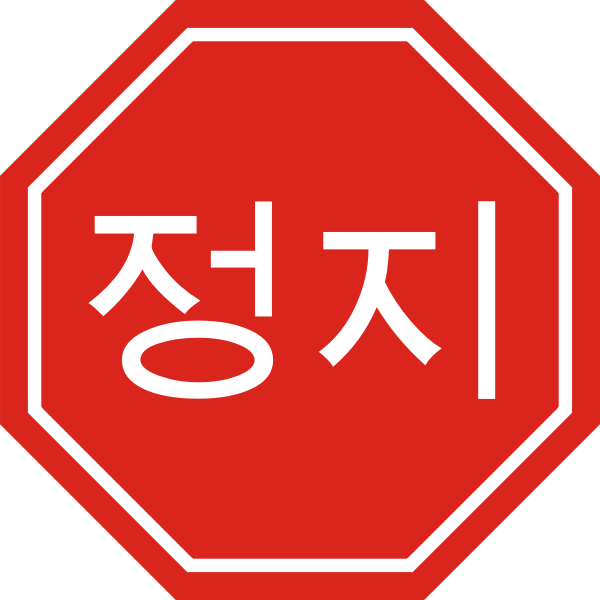
Korean stop sign, saying “Jeongji”. But for sure, many do have the English word STOP on them too.
Let us stop for a minute and have something else here in Language Day - a quick look at the Korean language for us who know absolutely nothing about it!
This is a very simple introduction to Korean, and more precisely, the language spoken in South Korea.
Many of us Westerners don’t even know whether the Korean characters are alphabets or logographic characters like the Chinese script, or kanji in Japanese. Well, they are alphabets for sure, only not very recognizable. But watching one of the countless Korean series on Netflix or any of the other streaming services, we see and hear so much of the language that it might be interesting to know even just a wee bit of it, don’t you think!
Modern Korean is written in Hangul, and uses 24 basic letters and 27 complex letters. The word Stop 정지 in the stop sign that you see here consist of two syllables, jeong 정 and ji 지, and could be freely translated as quiet/still limbs. Which sounds funny, but is very descriptive. The first syllable jeong 정 means by itself “affection, attachment, goodwill, etc”. The concept of 정 is a topic that you definitely come across if you are studying Korean. The second syllable ji, 지, is a negator, among other things. But it also means limbs.
So that stop sign is a good place to start learning some Korean! And here is a whole sentence for you where the syllable 지 , the negator, is used:
웃 지 마
Woot-ji-ma!
Don’t laugh!
The syllable ma in that sentence is constructed with the sign for m and the sign for a - a written with a straight vertical line with a short extension on the right side in the middle of it. You see a lot of that one! That is the simple rule mixed with all the other, more complex rules.
The verb to laugh is woot-da 웃다, of which only the base woot 웃 is used in the sentence above, as it is followed by the negator ji. Then what is ma? That is the verb command “don’t”. So, Do not laugh!
And if you are into languages, you guessed it: the sound for i is written as a simple vertical line, like in the syllable 지, the first part of it indicating the letter j.
Now we are in a good pace for learning some more Korean:
https://www.youtube.com/watch?v=KN4mysljHYc
https://en.wikipedia.org/wiki/Korean_language
https://www.knowingkorea.org/contents/view/204/The-uniquely-Korean-concept-of-Jeong
https://www.learnwitholiver.com/korean/translate-word-94-%EC%A7%80
https://blogs.transparent.com/korean/what-is-jeong/
Updated 29.11.2021