There are a whole lot of loan words in English. Many more than you might think. Perhaps as much as 80% of words in the English language have a non-English origin. Most are of course from far back in time, but some are quite new. So new that you might recognize them right away if the source was your own mother tongue.
Below there is an alphabetical list of some of these words. The list is nowhere near perfect and neither is it meant to be. It just shows how diverse the source base is - which is no surprise really, given how international our lives are in these modern times.
Many loan words travel through many languages, and sometimes it is hard, perhaps even impossible, to determine what the origin is. Therefore this list too is at parts just indicative of probable origins. Hope you have fun with it!
ARABIC Safari is a Swahili word, but originates from the Arabic adjective safar (journey/traveling/voyaging). Sofa is derived from the Arabic word suffah (ledge/bench), cognates with the Aramaic word sippa (“mat”).
DANISH-NORWEGIAN ?? ?? (together: Old Norse) Husband originates hūsbōndi (householder) Knife from knifr.
DUTCH ?? Boulevard originates from bolwerk (via French ‘boulevard’). Brandy comes from the word brandewijn (burnt wine). Brooklyn is the anglicized version of the original name, after Breukelen, a town near Utrecht, Netherlands. Coleslaw is from 18th century koolsla (cabbage salad). Cookie comes from koekje, or the more informal koekie (biscuit). Dollar comes from (Rijks)daalder. Easel from ezel (donkey), as in schilders ezel (lit. painter’s donkey). Golf from kolf (bat, club) but also a game played with these.
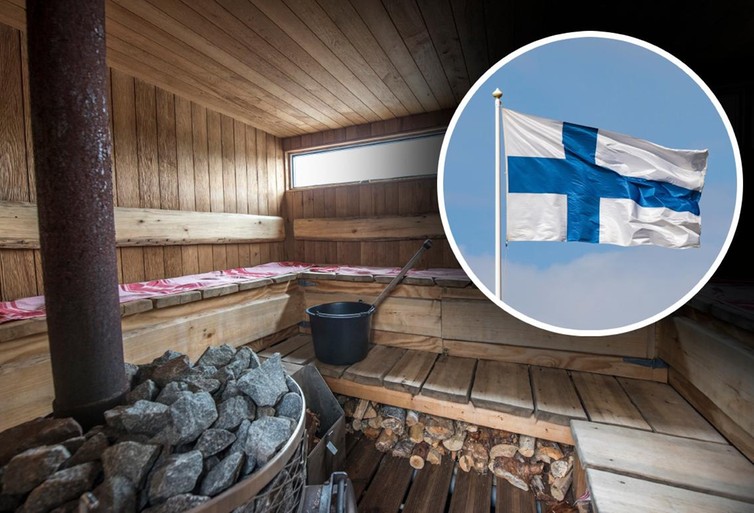
FINNISH ?? Sauna (pronunced as sou-nah in Finnish) is a small room or building designed as a place to experience dry or wet heat sessions, or an establishment with one or more of these facilities. Temperatures around 100 °C (212 °F) would normally be pretty intolerable but saunas overcome this problem by controlling the humidity. Sisu is a Finnish concept (pronounced as sisouh) described as stoic determination, tenacity of purpose, grit, resilience, and is held by Finns themselves to express their national character.
FRENCH ?? Coup d’état (French for blow of state), usually shortened to coup, is the seizure and removal of a government and its powers. Déjà vu means “already seen” in French, and is of course the sense of having experienced the present situation before. Haute couture (high sewing or high dressmaking) is the creation of exclusive custom-fitted clothing.
GERMAN ?? Doppelgänger or doppelganger is a biologically unrelated look-alike, or a double, of a living person. From German doppel (double) and gänger (walker). In fiction and mythology, a doppelgänger is often portrayed as a ghostly or paranormal phenomenon. Kindergarten (children’s garden)
GREEK ?? Some Greek words were borrowed into Latin and its descendants, the Romance languages, but by far the largest Greek contribution to English vocabulary is the huge number of scientific, medical, and technical neologisms that have been coined by compounding Greek roots and affixes to produce novel words. Chair comes originally from καθέδρα (the raised throne of a bishop in the early Christian basilica). Photography from φῶς (light) + γραφικός (picture). Utopia (οὐ/not + τόπος/place). Zoology (ζῷον/animal + λογία/knowledge)
HAWAIIAN Lei garland of flowers and/or leaves to be worn around the neck. Taboo comes either from the Hawaian word kapu, or from Maori, Tongan, Samoan, Tahitian tapu or Fijian tabu. Wiki is from wiki (quick).
HINDI ?? Bandana from bandhna (to tie). Cheetah from chītā, meaning “variegated. Jungle is from the Sanskrit word jaṅgal (uncultivated land). Pyjamas comes from Hindi and Urdu (paijaamaa) meaning “leg garment”, coined from Persian. Shampoo comes from Hindustani chāmpo (verb meaning “rub!"). Typhoon from the Urdu word toofaan (cyclonic storm).
ILOCANO ?? Yo-yo, this ancient toy with proof of existence since 500 BCE, came to be known as yo-yo in the United States thanks to a Filipino immigrant named Pedro Flores, who opened the Yo-Yo Manufacturing Company in Santa Barbara, California, in 1928.
IRISH ?? Clock comes from Old Irish clocc (bell). Hooligan comes from the Irish family name Ó hUallacháin, anglicised as O’Houlihan), one who takes part in rowdy behaviour and vandalism. Whiskey comes from uisce beatha (water of life). This Gaelic word shares its ultimate origins with Germanic water and Slavic voda of the same meaning. Distilled alcohol was aqua vitae (water of life) in Latin, and this was translated as uisce beatha in Irish and uisge beatha in Scottish Gaelic.
ITALIAN ?? Al dente is Italian for to the tooth, and describes pasta or rice that is cooked to be firm to the bite, thus involving a brief cooking time. Cosa Nostra (Italian for our thing), the word used in the United States of the organization often referred to by its members as Cosa Nostra and by the American government as La Cosa Nostra (LCN). Dolce vita (sweet life) is Italian for a life of pleasure and luxury. And a whole bunch of musical terms: adagio, alto, crescendo, forte, lento, mezzo forte, piano, volante - to name just a few.
JAPANESE ?? Futon is a flat mattress with a fabric exterior stuffed with cotton, wool or synthetic batting. Karaoke comes from the words kara (empty) and ōkesutora (orchestra), and is interactive entertainment where people sing along to recorded music using a microphone. Katana is a Japanese sword characterized by a curved, single-edged blade with a circular or squared guard and long grip to accommodate two hands. Sudoku (single number) is a number placement puzzle. Tsunami (harbor wave) is a large wave caused by earthquakes or other underwater disturbances.
LATIN So many words and expressions here that we don’t even go there. Dealt with off and on in the articles of Monthly Latin here in Journeys of Life.
NORWEGIAN ?? Fjord (a long indentation of a sea). Lemming (original Norwegian word for the rodent is lemen). Quisling (a traitor, from Vidkun Quisling). Slalom (slalåm, “sla”(slightly inclining hillside) and “låm” (track after skis). Telemark (a type of ski turn or style of skiing named for the Telemark region in Norway).
PORTUGUESE ?? Veranda from Hindi baramdaa, but ultimately from Portuguese.
RUSSIAN ?? Blini (блины), thin pancakes or crepes traditionally made with yeasted batter. Kefir (кефи́р), a fermented milk drink made with kefir “grains”. Mammoth (ма́монт mamont), originally from Yakut, probably based on the word mama (earth), and that perhaps from the notion that the animal burrowed in the ground).
SPANISH ?? Las Vegas (the meadows), Los Angeles (the angels), mesa (table), mosquito (literally little fly). And countless anglicizations of originally Spanish words, for example alligator (el lagarto/lizard), lasso (lazo/tie), tornado (tronada/thunderstorm).
Speaking about mosquitoes, there is an interesting article on How to get rid of black and white mosquitoes in this neat site that deals with pest problems, and also gives good information on the subject - How I Get Rid Of. These mosquitoes are by the way also called the Asian Tiger Mosquitoes, and are just one of over 3000 mosquito species in the world.
Then, a few more languages to round off this article.
SWAHILI Safari is a Swahili word, but originates from the Arabic adjective safar (journey/traveling/voyaging).
SWEDISH ?? Ombudsman is an official or public advocate who is usually appointed by the government or by parliament but with a significant degree of independence. The typical duties of an ombudsman are to investigate complaints and attempt to resolve them. Smorgasbord (smörgåsbord in Swedish) is served buffet-style with multiple hot and cold dishes of various foods on a table.
TURKISH ?? Bergamot comes through French bergamote ultimately from Turkish bey armudu (the bey’s pear). The game of Bridge comes through the Russian бирич biritch, originating from the Turkic word for “bugler” (in modern Turkish: borucu, borazancı), or might have come from a Turkish term bir, üç (one, three). Coffee comes from Ottoman Turkish kahve (coffee). Kiosk is from the Turkish köşk, an open summerhouse or pavilion. Yogurt is from Turkish yoğurt.
That’s it. If there is anything you want to add here, please leave a comment, and we’ll look into it!
LINKS
https://www.lexico.com/explore/foreign-words-and-phrases
https://www.babbel.com/en/magazine/english-words-actually-spanish
https://en.wikipedia.org/wiki/List_of_English_words_of_Turkic_origin
https://en.wikipedia.org/wiki/List_of_English_words_of_Scandinavian_origin
https://www.brainscape.com/academy/foreign-words-used-english/
https://www.dictionary.com/e/word-origins/
https://howigetridof.com/black-and-white-mosquito/
Updated 24.2.2022