
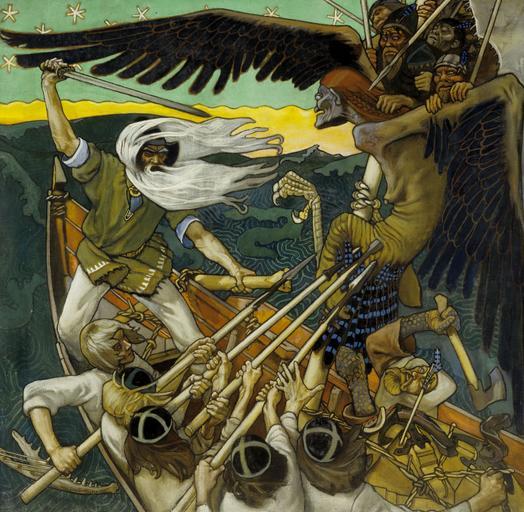
Today is Kalevala Day in Finland, celebrated each February 28th in honor of the Finnish national epic, Kalevala. So here is, for anyone interested in the Finnish language and folklore, Kalevala a là Journeys of Life!
The first edition of the Kalevala appeared in 1835. It was compiled and edited by Elias Lönnrot on the basis of the epic folk poems he had collected in Finland and Karelia.
Not that long ago, Kalevala used to be something that Finnish kids got acquainted with in the third grade, having to learn a few lines by heart and then recite them in front of the class.
In that tender age, it was for many a child a formidable task. So, it could possibly be something that they would later on in their lives always associate with stage fright. Alas, such is the power of the 8-syllable lines that it transcends “such petty human feelings”, and even bring some of us to make our own “power lines” for everyday events, such as walking with the rhythm of Kalevala.
Or if eight syllables seem like too much, then perhaps seven would do. But always keeping up with the spirit of Kalevala. That is, each line followed by the same amount of syllables to keep the rhythm! This rhythm would not be possible where it not for the Finnish language being so strongly a syllable language.
Kalevala has been translated into numerous languages, and studied by thousands of people around the globe. Yet it remains enigmatic and spellbounding. The stories are interesting, and transcend time. We have compiled here a list of the most foremost translators, in chronological order.
So far Kalevala has been translated into sixty-one languages and is Finland’s most translated work of literature.
The list of the translators of Kalevala
Franz Anton Schiefner (1817-1879) was a Baltic German linguist, tibetologist and the first translator of Kalevala. Born in Reval, Estonia, Russian Empire (1879/62), he was one of the greatest authorities on the philology and ethnology of the Finnic languages. He edited and translated Kalevala into German, published in 1852.
William Forsell Kirby (1844-1912) was an entomologist and folklorist who knew many languages. Born in Leicester, he translated Kalevala from Finnish, and carefully reproduces in his work the Kalevala meter. It was a major influence on the writings of J.R.R. Tolkien who first read it in his teens.
John Martin Crawford (1845-1916) was an American physician and scholar who was born in Herrick, PA USA. His English translation of Kalevala was based on the 1852 German translation by Franz Anton Schiefner, to be published for the first time in 1888.
Eino Friberg (1901-1995) was a Finnish-American author, best known for his 1989 translation of Kalevala. Born in Merikarvia, GD of Finland (1995/94), he came to the United States at age 5. He began to translate Kalevala into the English at the age of 75, working from a Braille copy as he was blind since childhood. This was the first time Kalevala had been translated by a native Finnish speaker into English, and was the fourth full translation overall.
Updated 28.2.2022
https://en.wikipedia.org/wiki/Kalevala
https://finland.fi/arts-culture/kalevala-the-finnish-national-epic/